






Sustainability
EXEDY Group's Sustainability Activities
Corporate Governance
Basic Approach to Corporate Governance
Under its corporate philosophy, 'Creation of Fulfillment (for Society, Customers, and Employees),' we recognize that thorough compliance management and the establishment of a robust corporate governance framework form the foundation of management, enabling the sustainable enhancement of corporate value.
In June 2026, we transitioned from an Audit & Supervisory Board Company to a Company with Nominating Committee, etc. Through this transition, we aim to further clarify the separation between supervisory and execution functions, strengthen the oversight function of the Board of Directors, and enhance the transparency and speed of decision-making.
We will continue to strengthen our compliance management and governance framework and will enhance our corporate governance in accordance with the following basic policies.
Basic Policy
- We will ensure the protection of shareholders' rights and equal treatment, and strive for constructive dialogue with shareholders.
- We will strive for appropriate collaboration with stakeholders other than shareholders, including customers, business partners, creditors, local communities, and employees.
- We will endeavor to ensure appropriate information disclosure and transparency.
- We will ensure that the Board of Directors appropriately fulfills its roles and responsibilities so that transparent, fair, swift, and decisive decision-making is achieved.
Management Structure for Decision-Making, Execution, and Supervision, and Other Corporate Governance Framework
Organizational Structure and Operation
| Organizational Form | Company with Nominating Committee, etc |
|---|
Board of Directors
| Chairman of the Board | President |
|---|---|
| Number of Directors | 7 |
| Number of Outside Directors | 4 |
| Number of Independent Outside Directors | 4 |
Functions Related to Business Execution, Audit and Supervision, Nomination, and Compensation (Overview of the Current Corporate Governance Structure)
We transitioned from an Audit & Supervisory Board Company to a Company with Nominating Committee, etc. as of the conclusion of the 76th Annual General Meeting of Shareholders held on June 19, 2026.
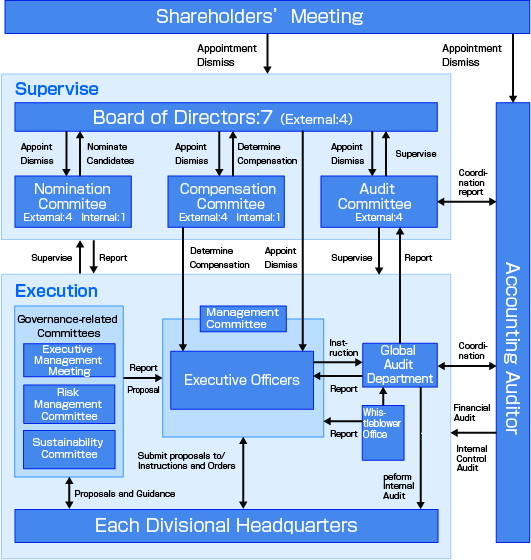
The Board of Directors consists of 7 directors, including 4 outside directors, and makes management decisions after thorough deliberation at regularly scheduled monthly meetings as well as extraordinary meetings held as necessary.
By appointing 4 independent outside directors, who constitute a majority of the Board, we strengthen its monitoring and supervisory functions, ensures transparency and objectivity in management, and strives for sustainable growth and the enhancement of mid- to long-term corporate value.
In principle, the Board of Directors delegates decision-making authority over business execution to Executive Officers, except for matters stipulated by law and those defined in the Board Regulations as having a significant impact on the management of the Group.
Decisions on important matters relating to the Group’s management, as defined in the Management Meeting Regulations, are made by the Management Committee, which consists of all Executive Officers and is, in principle, convened twice a month.
The Nominating Committee consists of 5 directors, including 4 outside directors, and is chaired by an outside director.
The Committee formulates succession plans and selects candidates for directors and executive officers. It submits proposals concerning candidates for directors to the General Meeting of Shareholders, while proposing candidates for executive officers to the Board of Directors.
The Compensation Committee consists of 5 directors, including 4 outside directors, and is chaired by an outside director.
The Committee deliberates on and determines policies for the compensation of directors and executive officers, as well as individual compensation.
The Audit Committee consists of four 4 outside directors.
The Audit Committee audits the execution of duties by directors and executive officers, prepares audit reports, and determines the content of proposals regarding the appointment, dismissal, or non-reappointment of the accounting auditor to be submitted to the General Meeting of Shareholders.
In addition, we convene a Risk Management Committee as necessary to address Group-wide issues and discuss measures to prevent recurrence.
We have entered into liability limitation agreements with its Outside Directors pursuant to the provisions of the Articles of Incorporation. Under these agreements, the maximum amount of liability for damages is limited to the minimum liability amount prescribed in Article 425 of the Companies Act.
The certified public accountants who conducted our financial audits were Mr. Ryuichi Sakai and Mr. Kazuyuki Kitano of PwC Japan LLC. In addition to conducting regular audits, they provide advice on accounting matters as necessary.
We maintain advisory agreements with legal counsel and has also engaged external specialists for tax-related matters. Professional advice is obtained from these experts as necessary. With respect to our internal control system, the Global Audit Department, an independent audit department reporting directly to the President and consisting of eight members, conducts operational audits and compliance reviews across all departments.
The Global Audit Department and the Full-time Audit & Supervisory Board Member (the Global Audit Department and the Audit Committee from July 2026 onward) conduct operational audits covering compliance with laws and regulations, anti-bribery and anti-corruption measures, and other relevant areas in order to ensure the effectiveness of corporate ethics and compliance programs.
Audit results are reported to the Representative Director and the Audit & Supervisory Board (the Representative Executive Officer and the Audit Committee from July 2026 onward), and corrective actions are implemented as necessary to strengthen internal controls.
In addition, the Global Audit Department conducts annual risk assessments based on the Group's management policies and key risks. Based on these assessments, audit themes and audit plans are established, and audits are conducted in accordance with the plans at the Company and its domestic and overseas affiliates. Special audits are also conducted whenever necessary, and the effectiveness of the compliance framework is continuously evaluated through these audit activities.
Furthermore, follow-up reviews are conducted on the status of corrective actions based on audit findings, thereby contributing to the enhancement of governance standards throughout the Group.
Our Reasons for Selecting Our Current System of Corporate Governance
We transitioned to a Company with Nominating Committee, etc. structure to further strengthen corporate governance by enhancing the transparency and objectivity of management through the separation and reinforcement of execution and oversight functions, while also enabling swift decision-making and business execution in response to changes in the business environment.
To strengthen the oversight function and improve transparency from the perspectives of independence and objectivity, we appoint independent outside directors as a majority of our Board of Directors. In addition, all chairpersons of the Nominating Committee, Compensation Committee, and Audit Committee are independent outside directors.
By continually enhancing our corporate governance framework under this structure, we aim to increase our corporate value over the medium to long term.
Status of Initiatives Concerning Shareholders and Other Stakeholders
1. Status of Initiatives to Promote Active Participation in General Meetings of Shareholders and Facilitate the Exercise of Voting Rights
| Early Distribution of Convocation Notices for General Meetings of Shareholders | We enable shareholders to exercise their voting rights via the Internet. |
|---|---|
| Electronic Exercise of Voting Rights | Since the 65th Annual General Meeting of Shareholders held on June 26, 2015, we have enabled the exercise of voting rights by electronic means, including via the Internet. |
| Participation in the Electronic Voting Platform and Other Measures to Improve the Voting Environment for Institutional Investors | We participate in the electronic voting platform operated by ICJ, Inc., thereby enhancing the voting environment for institutional investors. |
| Provision of English-Language Convocation Notices (Summary Version) | We provide an English-language summary version of the notice of convocation. |
| Additional points | We strive to make our General Meetings of Shareholders more accessible and easier to understand for a wide range of shareholders by using visual presentations, such as slides, in our business reports and by providing sign language interpretation services. |
2. IR activities
| Holding financial results briefings for securities analysts and institutional investors. | We hold interim and year-end financial results briefings in Tokyo for securities analysts and institutional investors. Presentation materials and video recordings of these sessions are available on our website. (https://www.exedy.com). |
|---|---|
| Providing opportunities for briefings for overseas investors. | Briefings for overseas analysts and institutional investors, which had been suspended since the COVID-19 pandemic, are scheduled to resume from the current fiscal year. |
| Disclosing of IR materials on the website | On our website(https://www.exedy.com), we publish financial results presentation materials, earnings reports, convocation notices, and integrated reports on its website, including English-language materials. |
| IR Organization and Personnel | The ESG & IR Promotion Department has been established, and dedicated personnel are responsible for IR activities. |
3. Initiatives Respecting Stakeholders
We recognize that value co-creation with a wide range of stakeholders—including employees, business partners, customers, creditors, and local communities—is essential, and we promote appropriate collaboration with multiple stakeholders.
From the perspective that the appropriate distribution of profits and outcomes generated through value co-creation and productivity improvements to diverse stakeholders contributes to sustainable economic development, and recognizing the importance of providing returns to employees and showing consideration for business partners, we will advance the following initiatives.
| Policies on Respect for Stakeholders | Our management philosophy is to respond to the trust placed in us by shareholders and other stakeholders through the sustainable growth of our business by achieving higher standards of “Contributing to Society,” “Serving Our Customers,” and “Employee Happiness.”To put this philosophy into practice, we have established the EXEDY Code of Conduct and ensure that it is communicated to all officers and employees. |
|---|---|
| The Implementation of Environmental Safety and CSR Activities | Recognizing that it is our responsibility as a corporation to give full consideration to the impact of our business activities on the natural environment and society, we actively promote environmental initiatives. The results of these activities are disclosed on our website for each fiscal year.The results of these activities are disclosed on our website for each fiscal year. In addition, information on our sustainability initiatives, including environmental conservation activities, is available on our website and in our Integrated Report. |
| Additional Points | Regarding the policy and Initiatives for Women's Empowerment At EXEDY and our Group companies, we promote the recruitment of women for manufacturing positions and encourage the appointment of women to managerial and leadership positions. In addition, women have been appointed as Directors and Audit & Supervisory Board Members at EXEDY and our Group companies.Under our Long-Term Vision, we have established the ratio of women in management positions and the appointment of female and non-Japanese directors as key performance indicators (KPIs) to promote diversity and inclusion. |
Regarding Our System of Internal Control
Our Basic Approach to and Development of the Internal Control System
We position the fulfillment of corporate social responsibilities, including compliance, corporate ethics, and environmental initiatives, and the enhancement of social trust as part of its management policy.
We transitioned from a Company with an Audit & Supervisory Board to a Company with Nominating Committee, etc. upon the conclusion of the 76th Annual General Meeting of Shareholders held on June 19, 2026.
In conjunction with this transition, we resolved the Basic Policy on the Internal Control System at the Board of Directors meeting held on June 19, 2026, as outlined below. We will report on the status of internal controls to the Board of Directors as necessary.
1. System for Retention and Management of Information Related to the Execution of Duties by Executive Officers
We appropriately retain and manage information related to business execution in accordance with internal regulations on document retention and confidential information management.
2. Regulations for risk management
We designate Corporate Strategy Promotion Headquarters as the central unit for comprehensive risk management and promotes activities to prevent potential losses.
3. Ensuring Efficient Execution of Duties by Executive Officers
In principle, the Board of Directors delegates decision-making authority over business execution to Executive Officers.
With respect to matters delegated to Executive Officers for the execution of business operations, matters stipulated in the Management Committee Regulations as important matters relating to the management of our Group are resolved by the Management Committee, which is composed of all Executive Officers and, in principle, meets twice a month. Other matters are determined by the relevant Executive Officer in charge in accordance with the approval authority set forth in our internal regulations.
4. Ensuring Compliance with Laws and the Articles of Incorporation
We have established the EXEDY Code of Conduct and promote compliance with laws, regulations, the Articles of Incorporation, and internal rules among Executive Officers and employees. In addition, we ensure compliance-oriented management in accordance with the Internal Whistleblower Protection Regulations. Furthermore, the Global Audit Department, an independent audit function reporting directly to the President, audits the operation of our organizational structures and systems, as well as compliance with internal regulations and other rules.
5. Ensuring the Appropriateness of Operations within the Group
We centrally manage Group companies in accordance with the Affiliate Management Policy through the Corporate Strategy Promotion Headquarters.
1) System for reporting to us on matters concerning the execution of duties by directors of Group companies
The execution status of Group companies is monitored through monthly reports, and important matters are reported to and deliberated by the Board of Directors and the Management Committee.
2) Risk Management for Group Companies
We implement loss prevention activities in accordance with the Risk Management and Compliance Regulations, which apply to our Group companies.
3) System for Ensuring the Efficient Execution of Duties by Directors of Group Companies
We formulate a consolidated medium-term management plan, share throughout the Group the objectives and issues necessary to achieve the plan, and strive to ensure an efficient system for the execution of duties.
6. Ensuring Compliance with Laws and the Articles of Incorporation by Directors, Officers and Employees of Group Companies
We distribute booklets of the EXEDY Code of Conduct to officers and employees of Group companies, translating them as necessary, and ensure that the Code is fully communicated and understood. The Global Audit Department audits the operation of organizational structures and systems at Group companies, as well as compliance with internal regulations and other rules, in accordance with the Internal Audit Regulations and the Affiliated Company Management Regulations.
7. Matters Concerning Directors and Employees Who Assist the Audit Committee in the Performance of Its Duties
We establish an Audit Committee Secretariat and assign dedicated employees to assist the Audit Committee in the performance of its duties. We may also assign employees to serve concurrently in the Audit Committee Secretariat when necessary.
8. Matters Concerning the Independence of Directors and Employees Assisting the Audit Committee from Executive Officers
We report in advance to the Chairperson of the Audit Committee and seek his or her opinion regarding personnel transfers, evaluations, and disciplinary actions involving employees serving in the Audit Committee Secretariat.
9. Matters Concerning Ensuring the Effectiveness of Instructions Given to Directors and Employees Assisting the Audit Committee
Employees serving exclusively in the Audit Committee Secretariat shall comply with the directions and orders of the Audit Committee.
10. System for Reporting to the Audit Committee
1) System for Directors, Executive Officers, and Employees to Report to the Audit Committee
Our Directors, Executive Officers, and employees shall immediately report to the Audit Committee any facts that may cause significant damage to the Group.
2) System for Officers and Employees of Group Companies, or Persons Receiving Reports from Them, to Report to Our Audit Committee
Officers and employees of the Group shall promptly provide appropriate reports when requested by our Audit Committee regarding matters related to the execution of business operations.
11. Ensuring that Persons Reporting to the Audit Committee Are Not Subject to Disadvantageous Treatment Because of Such Reporting
Under the Whistleblower Protection Regulations, we do not dismiss or otherwise disadvantage individuals who make inquiries or report concerns through internal reporting channels on the grounds of such reporting.
12. Matters Concerning the Policy for Advance Payment or Reimbursement of Expenses Incurred in the Performance of Duties by Audit Committee Members and the Processing of Related Expenses or Liabilities
When an Audit Committee Member requests an advance payment or reimbursement of expenses pursuant to the Companies Act in connection with the performance of his or her duties, we shall promptly process such expenses or liabilities unless they are deemed unnecessary for the performance of those duties. We allocate a designated annual budget to cover expenses incurred in the performance of duties by Audit Committee Members.
13. Other Systems to Ensure the Effectiveness of Audits Conducted by the Audit Committee
We maintain a system under which Audit Committee Members or staff members of the Audit Committee Secretariat may attend Management Committee meetings and other important meetings, thereby enabling them to continuously monitor the status of business execution.
14. Basic Policy for Eliminating Anti-Social Forces
The EXEDY Code of Conduct stipulates that we firmly oppose anti-social forces and organizations that threaten the order and safety of civil society, and we ensure that this policy is thoroughly communicated to all employees.
Basic Policy for Eliminating Anti-Social Forces and Status of Related Systems
In the EXEDY Code of Conduct, we stipulate that we will firmly oppose anti-social forces and organizations that threaten the order and safety of civil society, and we ensure that this policy is thoroughly communicated to all employees.
Based on this policy, we have established a department responsible for responding to anti-social forces and have put in place a system to address illegal acts and unjust demands.
We have also set forth procedures for responding to anti-social forces in the EXEDY Code of Conduct, which is distributed to all employees to ensure full awareness and understanding.
Status of Board of Directors and Management Committee Meetings
We held 12 Board of Directors meetings and 25 Management Committee meetings, striving to ensure efficient business execution. We also held four Risk Management Committee meetings to address issues affecting the Group as a whole and discuss measures to prevent recurrence.
We also regularly conduct investigations into risk-related matters, including those involving Group companies, and important matters are reported to the Board of Directors.
In addition, we share information on risk-related matters among Group companies and strive to ensure appropriate business execution.
The Global Audit Department systematically conducts operational audits and compliance checks of us and our Group companies, and regularly reports the results to the full-time Audit & Supervisory Board Members.
The full-time Audit & Supervisory Board Members attend Management Committee meetings and Risk Management Committee meetings and strive to understand the status of business execution.
We work to enhance information security governance by conducting security training for officers and managers, and to improve compliance and corporate ethics through compliance training, human rights training, and initiatives to promote harassment-free and comfortable workplaces.
In addition to our internal reporting hotline, we have established a consultation desk for matters related to business ethics across the Group. We have also established the EXEDY Hotline, through which employees can directly consult with and report matters to external attorneys, as part of our efforts to prevent misconduct and detect issues at an early stage.
To ensure thorough awareness of these systems, the EXEDY Code of Conduct, which is distributed to all Group members, clearly identifies the consultation desks and helps raise awareness of compliance.
Nomination and Remuneration Governance
Nomination Committee
The Nomination Committee consists of 5 Directors, including 4 Independent Outside Directors, and is chaired by an Independent Outside Director. The Committee establishes policies and procedures for the appointment and dismissal of Directors and Executive Officers and is responsible for developing an optimal management structure aligned with the Company's management strategy and business characteristics. Utilizing tools such as the skills matrix and succession planning, the Committee identifies and evaluates candidates, helping to strengthen the management framework while enhancing the transparency and objectivity of the nomination process for Directors and Executive Officers.
Policy and Procedures for the Appointment and Dismissal of Directors and Executive Officers
In fiscal 2025, under the voluntary Nomination Committee (Chair: Independent Outside Director; Members: 4 Independent Outside Directors and 1 Internal Director), we undertook preparations for its transition to a Company with a Nominating Committee, etc. structure in June 2026. Specifically, the Committee identified candidates for Directors, Executive Officers, and members of each statutory committee (Nomination, Remuneration, and Audit Committees) under the new governance framework and submitted its recommendations to the Board of Directors. Based on these recommendations, the executive and governance structure for fiscal 2026 was determined.In addition, the Nomination Committee reviewed the entire nomination process, including defining the qualifications and competencies required of Directors and Executive Officers, reassessing the skills composition of the Board and management team, identifying candidate pools, and refining procedures for individual appointments and dismissals. The Committee also expanded the pool of high-potential executive candidates and conducted interviews with candidates, which has contributed to enhancing succession planning and strengthening the nomination process. From fiscal 2026 onward, the Nomination Committee will continue to review the candidate selection process for Directors and Executive Officers. The Committee will continue to strengthen the management structure by maintaining transparent and objective nomination processes and regularly updating succession plans from a medium- to long-term perspective.
Compensation Committee
The Compensation Committee consists of 5 Directors, including 4 Independent Outside Directors, and is chaired by an Independent Outside Director. In addition to formulating the basic policy on compensation for Directors and Executive Officers and determining individual compensation, the Committee continuously reviews the compensation system and performance evaluation metrics in light of our management strategy and changes in the business environment. In FY2026, the Committee reviewed both the bonus program and the performance-linked stock compensation plan.
Executive Compensation
Basic Policy
At the Remuneration Committee meeting held on June 19, 2026, we resolved to adopt the policy for determining remuneration for Directors and Executive Officers. Our executive compensation policy is designed to function effectively as an incentive for the sustainable enhancement of corporate value. Accordingly, remuneration is linked to shareholder interests and is set at an appropriate level commensurate with the responsibilities of each Director and Executive Officer. Remuneration for Executive Officers responsible for business execution consists of base salary, bonuses, and performance-linked stock compensation. In contrast, Independent Outside Directors, who are responsible for supervisory functions, receive only base salary in consideration of the nature of their duties.
Compensation Mix
Executive Officers' compensation consists of base salary and bonuses paid in cash as short-term incentives, together with performance-linked stock compensation designed to promote sustainable growth in corporate value and strengthen alignment with shareholder interests over the medium to long term. With regard to cash compensation, approximately 80% of the annual cash remuneration is composed of fixed monthly salary, while approximately 20% is allocated as the target bonus amount.
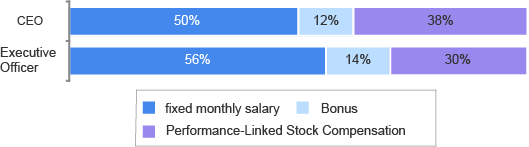
※Illustrative percentages based on the achievement of 100% of fiscal 2026 performance targets.
※The remuneration structure is designed so that the proportion of performance-linked stock compensation as a percentage of total remuneration increases according to executive rank.
Bonuses
At the Remuneration Committee meeting held on June 19, 2026, we reviewed the methodology for determining bonuses. Bonuses are designed to incentivize short-term performance improvement and contributions to sustainable corporate value creation. They are calculated based on the level of achievement of both common KPIs and individual KPIs established according to each Executive Officer's position and responsibilities. The weighting of individual KPIs is determined by the Remuneration Committee within a range of 0% to 50%, depending on the Executive Officer's position. The weighting assigned to common KPIs is calculated as 100% minus the individual KPI weighting. This structure ensures that bonuses reflect both the achievement of Group-wide performance targets and the results achieved within each Executive Officer's area of responsibility. The common KPIs are consolidated ROE, consolidated operating profit, and the Net GHG reduction rate. Depending on the level of achievement of each KPI, the payout rate against the target bonus amount ranges from 0% to 120%.
Bonus KPIs and Weighting
KPI Category |
KPI |
Weight in Bonus Calculation |
Target (FY2026) |
Payout Rate |
|---|---|---|---|---|
Common KPI |
Consolidated ROE |
Common KPI Weight×50% |
7.5% |
0~120% |
Consolidated Operating Profit |
Common KPI Weight×35% |
¥24.5 billion |
0~120% |
|
Net GHG Reduction Rate (Scope 1+2) |
Common KPI Weight×15% |
16.8% reduction vs. FY2022 |
0~120% |
|
Individual KPI |
Individually established for each Executive Officer |
0%-50% (determined according to position) |
Set according to position and responsibilities |
0~120% |
Total |
- |
100% |
- |
- |
Performance-Linked Stock Compensation
At a meeting of the Compensation Committee held on June 19, 2026, we resolved to introduce a performance-linked restricted stock compensation plan settled following the performance period for Executive Officers, replacing the conventional restricted stock compensation plan. The purpose of this plan is to promote greater alignment of interests between executives and shareholders, while strengthening the linkage between executive compensation, Company performance, and shareholder value, thereby providing incentives for the sustainable enhancement of corporate value over the medium to long term. The performance evaluation period is one year, and shares are granted following the completion of the evaluation period based on the achievement level of the performance indicators.
Stock Compensation KPIs and Weighting
KPI |
Target (FY2026) |
Weighting |
Payout Rate |
|---|---|---|---|
Consolidated ROE |
7.5% |
50% |
0~120% |
Relative TSR |
100% |
50% |
|
合計 |
Total |
Shares granted under this plan are subject to a 30-year transfer restriction period. Through the promotion of long-term share ownership by executives, the plan is designed to strengthen the alignment of interests with shareholders and enhance commitment to the sustainable growth of corporate value. Transfer restrictions are lifted upon the expiration of the restriction period or in cases of death or retirement for legitimate reasons.
Malus and Clawback Provisions
Under the performance-linked stock compensation plan, we may acquire, without consideration, restricted shares granted as compensation in cases where an executive has committed a material violation of applicable laws, regulations, or internal rules, retired without legitimate reason, engaged in activities that compete with the EXEDY Group, or otherwise met the conditions specified by us.
Disclosure of information related to corruption prevention
Internal consultation and internal reporting system
Corruption prevention
Based on the activity guidelines under the Sustainability Policy, the EXEDY Group conducts business in compliance with the laws and regulations of each country and region, as well as the spirit thereof, and recognizes that ensuring fair, transparent, and free competition is a fundamental rule of corporate activities.
We have also established and implemented the following detailed rules of conduct in our Code of Conduct.
- Laws and Regulations Related to Business Operations
1) Prohibition of cartels
2) Fair transactions with partner companies: understanding of the Antimonopoly Act, including abuse of a superior bargaining position, and the Subcontract Act, including unfair returns, price reductions, and failure to issue written orders - Entertainment and Gifts (Prevention of Bribery)
1) Prohibition of entertainment and gifts for the purpose of improper transactions
2) Obtaining approval from a supervisor when receiving entertainment - Prevention of Corruption
1) Compliance with the laws of each country when making political contributions or donations
2) Prohibition of entertainment, gifts, or monetary exchanges with customers or partner companies for the purpose of obtaining improper benefits or preferential treatment
Employee training
As described above, our approach to preventing corruption is incorporated into the Code of Conduct, and each department and team reads it aloud during daily morning meetings and other occasions to ensure thorough awareness of its content.
In addition, as part of rank-based training, we provide annual training on corruption prevention for newly appointed general managers, plant managers, office managers, deputy general managers, section chiefs, and team leaders, with 40 employees participating in FY2024.
Initiatives for Partner Companies
For new partner companies, we provide the Partner Company Sustainability Guidelines and request that they take initiatives to prevent corruption. With partner companies that agree to these initiatives, we enter into basic transaction agreements that incorporate provisions prohibiting bribery and requiring compliance with the prevention of corrupt practices.
For both new and existing partner companies, we ask them to conduct self-audits using the sustainability assessment sheet provided by us to evaluate risks related to compliance with competition laws and the prevention of corruption. In FY2024, 257 partner companies conducted these self-audits.
Response in the Event of Corruption
In the unlikely event that a serious case of corruption occurs, the officer responsible for overall risk management reports the facts and recurrence prevention measures to the Board of Directors.
Through reporting channels that ensure privacy protection and prevent disadvantageous treatment of those who consult or report, we broadly collect information on corruption-related matters, including violations of business laws and regulations and improper entertainment or gifts, including anonymous reports, and respond promptly when corruption occurs.